


The TEMCO Story
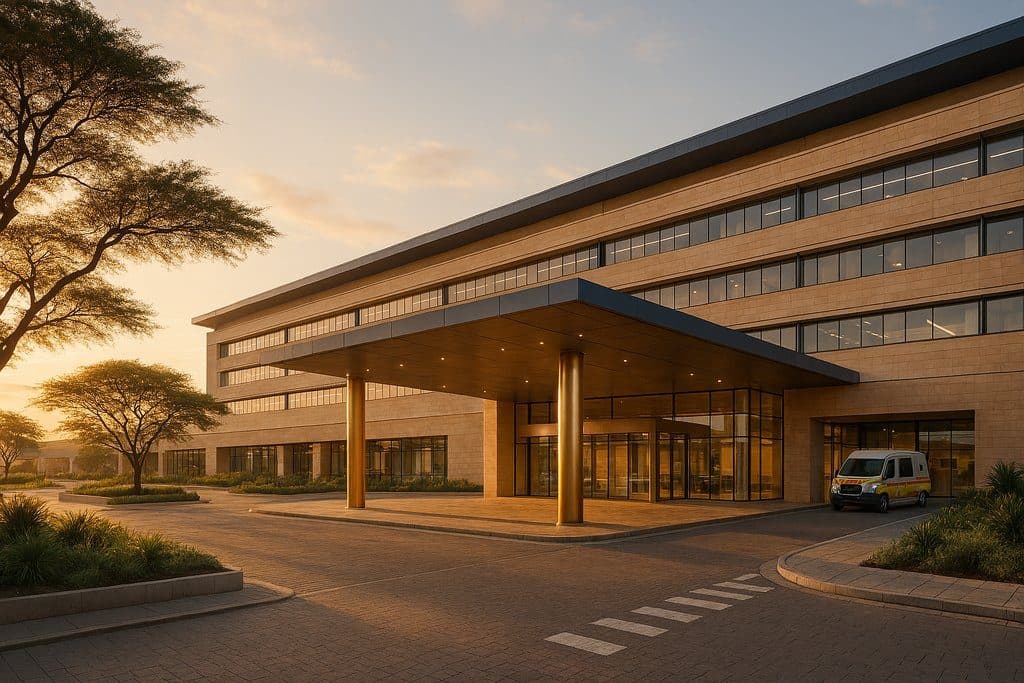
TEMCO is a 130-bed specialised hospital under development at the Gaborone airport Special Economic Zone, built for the whole of southern Africa and within about ninety minutes' flight of most of it. Regional patients pay in foreign currency, which makes specialist medicine a national export and keeps money in Botswana that has been leaving it for years. Opening 2029.
Built for the Whole Region
Across southern Africa, a family facing a diagnosis that needs specialist hands has usually had to arrange the travel before they can arrange the treatment. They travel out of Lusaka, Harare, Maputo and Gaborone itself for Johannesburg, and further still for Bengaluru or Dubai, and the cost of that travelling is rarely only the fare: it is weeks away from work, and a parent sleeping in a waiting room in a country whose language they do not speak, while the money paid for the treatment stays in that country too. Gaborone sits within about two hours' flight of most of the region, which means the care can sit there as well.
TEMCO is what a group of clinicians, engineers, lawyers and hospital operators arrived at together: a 130-bed specialised hospital at the Sir Seretse Khama International Airport Special Economic Zone, planned around two kinds of patient at once. Some will fly in from across the region and beyond for treatment that has meant leaving the continent until now, paying in foreign currency that lands in Botswana. Others will be Batswana arriving by public referral, on medical aid or privately, whose complex case is then handled at home. The same theatres and the same intensive-care beds serve both, which is how a hospital sized for a region becomes affordable for the country hosting it.
In practice that means one building holding the everyday work of a major hospital alongside the work that is rare anywhere. The planned clinical programme for 2029 includes radiation oncology on two linear accelerators with IMRT, VMAT, SBRT and SRS planning, structural heart and complex electrophysiology, neurosurgery, expanded dialysis and trauma, a robotic-assisted surgical platform that will be the first in Botswana, and a women's and children's service covering high-risk pregnancy care (obstetrics), neonatal and paediatric intensive care for newborn babies and children, children's surgery, gynaecological cancer of the cervix and ovaries, and IVF and fertility care for women and for men.
A National Export
Healthcare That Earns Abroad
Patients who fly in pay in foreign currency, the same way tourism and minerals earn it, so every regional patient treated in Gaborone is money arriving in Botswana instead of leaving it.
90 Minutes
From Most of the Region
Gaborone is a short flight from the cities the region's patients travel out of today, and an easy one for the family who travels with them.
25-35% Below
South African Private Rates
Care is planned at a quarter to a third under equivalent South African private rates, in a hospital held to an international accreditation standard from its first day, so nobody has to choose between the two.
Raising the Standard for the Whole Region
A hospital like this one earns its keep twice over. It treats the patients in front of it, and it sets a level of practice that the people around it can train against and be measured against. Two linear accelerators with redundancy, structural heart and complex electrophysiology, a robotic-assisted surgical platform that will be the first in Botswana, and an accreditation pathway followed from the opening day all describe a benchmark, and a benchmark, once it exists, pulls everything near it upward.
Every complex case treated inside the region is also a case whose surgeons, nurses, physicists and radiographers were trained inside the region, and that pool deepens with every year the hospital runs. More than two hundred specialists are to be trained and recruited over the operating period, and they stay in the country long after any one patient has gone home. A national health system grows by adding real capability, and no single institution manages that on its own.
A Specialist Training Pipeline
More than 200 specialists trained and recruited over the operating period, building clinical capacity that stays in Botswana long after any one case is closed.
Capacity Added to the Country
TEMCO will add tertiary beds, theatres and intensive care to the country's existing stock, so what Botswana can treat at home grows in absolute terms.
An International Accreditation Pathway
TEMCO will follow a Joint Commission International accreditation pathway from opening, so an international quality standard governs the hospital from its first patient, and it is one any regulator, insurer or family can look up and hold the hospital to.
Healthcare as an Export Industry
Treating the region's patients is an export business, earning foreign currency the way tourism and minerals earn it, and paying its wages and its tax inside Botswana. A hospital of this depth sits inside the country on that same volume, so what Batswana can reach without leaving home grows with it. The figures below are the modelled contribution across the first decade of operation.
740
Permanent Roles
Clinical, technical and operational posts at full operation, growing from 330 at opening and recruited first from Botswana.
2,300+
Jobs Over the Decade
Direct and indirect employment across the decade, plus around 300 construction roles through the build phase.
200+
Specialists Trained
Trained and recruited over the operating period, which builds capacity Botswana keeps and the wider region can draw on.
BWP 2.74bn (~US$200m)
GDP Contribution
Modelled contribution to Botswana's GDP across the first decade of operation.
BWP 422m (~US$31m) in Tax
Tax paid to the state across the first decade, revenue earned inside the zone framework that funds the wider public good.
Foreign-Exchange Earnings
Patients who fly in pay in foreign currency, which makes healthcare a national export and a net earner for Botswana in the same column as tourism.
Specialist Access Widened
Batswana on public referral, on medical aid and paying privately will reach the same theatres and the same specialists, and a complex case that has meant a visa becomes a drive across Gaborone.
Regional Patient Flow
Patients drawn from across the region through the airport catchment, landing at a terminal that sits minutes from the front door.
Mothers and Children First
Maternity and high-risk pregnancy care (obstetrics), neonatal and paediatric intensive care for newborn babies and children, children's surgery, gynaecological cancer of the cervix and ovaries, and IVF and fertility care for women and for men, all under one roof, so the mother with a difficult pregnancy and the baby who needs a ventilator at two in the morning are not the ones asked to travel.
Work Beyond the Wards
Rehabilitation, recovery medicine, accommodation for the families who travel with a patient and the businesses that serve them all grow around a hospital of this size, and that activity is counted in Botswana too.
Our Mission
We are building the hospital the region flies to, and the hospital Botswana no longer has to fly out of. That means the full range of specialist care at the airport Special Economic Zone, priced a quarter to a third under equivalent South African private rates, delivered by BHPC-registered practitioners working alongside international partners. It means foreign currency earned, several hundred permanent jobs held by Batswana, a material contribution to GDP, and a training pipeline that leaves more specialists in the region than it found.
It also means something plainer. A woman in Francistown carrying a high-risk pregnancy, a family in Lusaka whose child needs a paediatric intensive-care bed, a couple in Harare who have been trying for a baby for years and have been told the next step is a clinic on another continent, a patient in Maputo whose cancer needs radiation and surgery run as one programme: each of them should be a short flight from Gaborone, with a bed ready and a specialist expecting them. For the ones who do fly further, the referral runs the other way too, because the hospital is built to work with the international centres that hold the rarest cases. The doors open in 2029.
Our Principles
Six principles govern every decision here, in the clinical design and in the boardroom alike. Select one to see what it means in practice.
Principle 01 of 06
Clinical credibility comes first
Every design decision answers to evidence-based medicine and to standards recognised internationally, and what we put in front of a reader is numbers, dates and named systems they can check for themselves. Where a claim cannot be sourced, it stays out of the document.
Principle 02 of 06
Aligned with the national agenda
TEMCO is a Healthcare Entry Point Project under Botswana's Economic Transformation Programme and a priority under NDP 12, with delivery readiness validated by the BETP Secretariat. A hospital that earns foreign exchange for the country belongs inside the national plan, and this one is being built there.
Principle 03 of 06
Specialist access, widened
By 2029 a woman carrying a high-risk pregnancy, a child who needs intensive care and a patient booked for a structural-heart procedure all travel to the airport precinct instead of to Johannesburg or Bengaluru. We serve two streams at once: patients referred in from across the region, and Batswana at home, including public-referral and medical-aid patients alongside private ones.
Principle 04 of 06
A forex-earning national asset
Patients who fly in for treatment pay in hard currency, so a theatre list here earns foreign exchange for Botswana the way a lodge or a mine does, while the spend that leaves the country every year for treatment abroad stays at home. Healthcare becomes something the country exports, counted the same way tourism is counted.
Principle 05 of 06
Conceived and led by Batswana
The project is led and governed by Batswana professionals, with international partners brought in to deepen that leadership and answer to it. Specialist talent that left the country has a reason to come home, because a hospital serving the whole region carries enough complex work to hold a career.
Principle 06 of 06
Open governance, sourced numbers
We pursue the Joint Commission International accreditation pathway from the day the hospital opens, and the governance behind it is open to inspection, with finances that can be traced line by line. Anyone who checks a figure we publish will find the working behind it.
National-Priority Validation
TEMCO sits inside Botswana's own development and economic-transformation agenda, and five separate markers record that, each one earned in sequence and each held by a named authority.
NDP 12 Priority
National Development Plan 12 · 2025–2030
A priority project under National Development Plan 12, Botswana's plan for 2025 to 2030 and its route to high-income status by 2036, in which healthcare is one of the named sectors carrying that shift.
BETP Entry Point Project
Botswana Economic Transformation Programme
An Entry Point Project of the Botswana Economic Transformation Programme, accepted following the BETP Labs cohort. The programme sits under the Ministry of Finance, a portfolio held by the Vice President.
Ministry of Health
Letter of Support
Formal letter of support from the Ministry of Health, confirming clinical-sector endorsement of the project.
BETP Secretariat Validation
Delivery-Readiness Validation
BETP Secretariat delivery-readiness validation (Making The Most / MTM marker) of the financial model and delivery plan, following the BETP Labs cohort.
SEZ Licensed
Special Economic Zones Authority
Sept 2025 – Aug 2026
TEMCO entered the Special Economic Zone process at Sir Seretse Khama International Airport in September 2025. The Special Economic Zones Authority wrote in support of the project in December 2025, and the licence followed at board level in August 2026. The zone carries no customs duty on qualifying medical equipment, free repatriation of profit with no exchange controls, and no export mandate.
Partnerships and Delivery Model
The project team leads the work and holds the decisions, and the partnerships around it are chosen to add what the team does not already carry.
Clinical Operations Partner
Protocols, Staffing & Training
An experienced clinical operations partner from the region supplying protocols, staffing pipelines and training integration, bringing established clinical workflows and specialist recruitment networks to TEMCO's operational readiness.
BETP Secretariat
Model Reviewer
The TEMCO financial model and implementation plan were reviewed and validated through the BETP process, a delivery-readiness validation by the BETP Secretariat and an independent check on both the delivery plan and the economic assumptions underneath it.
Project Team-Led Delivery
Engineering, Procurement, Management
Engineering is delivered in-house by the project team, procurement is managed jointly with the contractors approached for the build, and management is project team-led with an explicit opening for a strategic investor partner bringing hospital-sector operating experience alongside capital.
Meet the Team Behind TEMCO
Clinicians, engineers, legal advisers and operational leads who came together to put a regional specialist hospital in Gaborone, and who will answer for it.